Case Study
Making Legacy Consumables Work with Automation
- Automation
- Robotics
- Workflow
- Healthcare
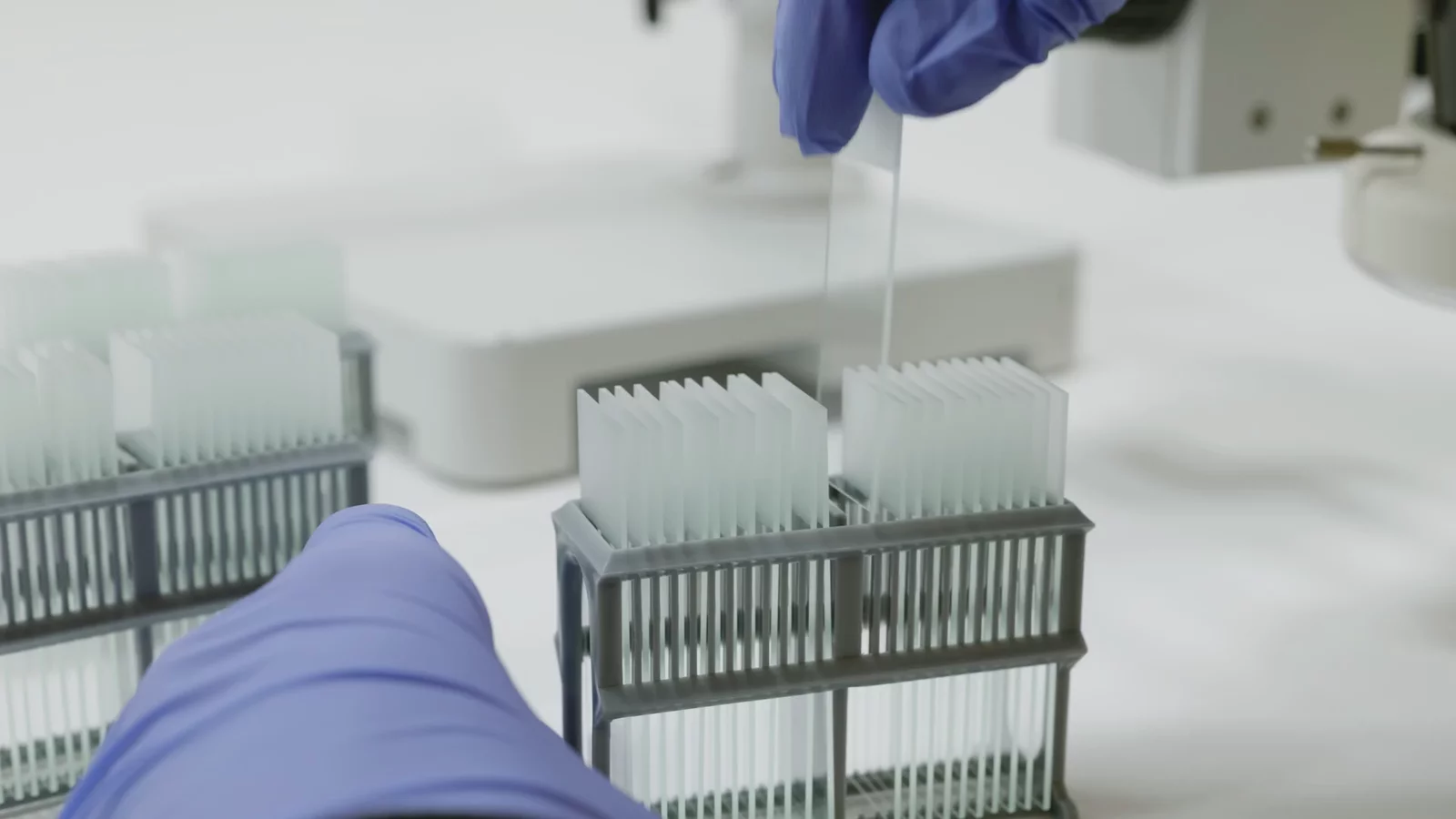
Hologic, a medical diagnostics company, was developing a high-throughput automation system that relied on slide racks originally designed for manual handling, not robotics. Rather than replacing those consumables with a more complex automation-friendly system, we redesigned how the automation interacted with the existing workflow.
Challenge
Technicians could compensate for slide inconsistencies instinctively, but robotic systems required predictable positioning to avoid damaged samples and workflow failures. The conventional solution was to introduce a new automation-specific carrier system, but that would have added equipment, transfer steps, validation requirements, and user friction across the lab workflow.
Solution
We reframed the challenge around predictability rather than precision. Instead of redesigning the consumable itself, we redesigned the interaction between the rack, the drawer, gravity, and the robot. By placing the racks at a slight angle, gravity naturally biased each slide into a consistent position when the drawer closed. This created a reliable picking condition without requiring new consumables or additional transfer steps.
We also extended this thinking into the broader workflow. Mechanical safeguards prevented racks from being inserted incorrectly, and the drawer-based architecture allowed urgent samples to be added without interrupting the full process.
Outcome
The final system successfully automated a workflow that initially appeared incompatible with robotics while preserving the customer’s existing consumables and lab process. The solution reduced system complexity, avoided unnecessary transfer steps, improved reliability, and created a more flexible user experience. Rather than forcing precision into the consumable, the system around it became smarter.